
View from the Hill

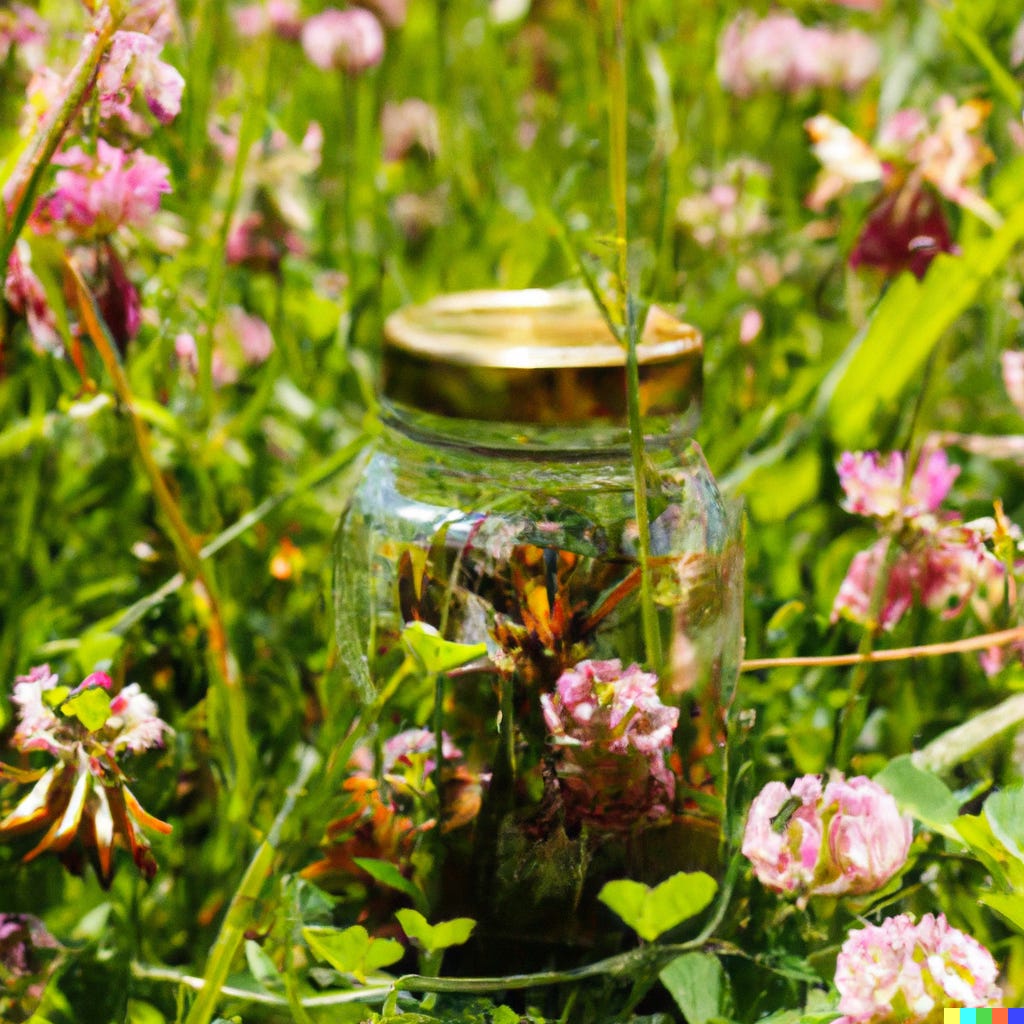
Buzzings vibrate through hot glass against my fingers. I turn my jam jar upside down. Wasps rise and tap their heads against the solid glass bottom. Their narrow wings beat and their pointy faces butt against boundaries they cannot see. I edge the lid open, add a few clover heads and buttercups, set the jar upright and watch. One or two now bang their heads against the lid. More turn, attracted to the flower heads. I put the jar down beside me in the long grass.
I watch the line of workers march past. Grasses spread from either side of the sandy surface under their boots. They descend in formation from the hill, their clothing grey against the greens and summer flowers. We called this place the sand pit or as we said the “sampit”; it is the route out of, “the cottages”, or, as they also called it, Hungry Hill. The County Council built cottages here in the 50s to ease overcrowding in the laneways of the town below. We came from such a laneway.
In my memory, the workers form a long, dark, caterpillar, winding its way in a great expanse of green. It crosses over to the grey of the town, onto the top of High Street, goes past Dicko’s grocer shop and the Grand Hotel. Then it moves onto Mangan’s Sweet Shop, and then Sheahan’s sweet shop. It travels across the road to that other little sweet shop, what was it called? It used to be my favourite. Why can’t I remember its name? Why are there so many sweet shops in my memory of High Street?
The line of workers goes past Aherne’s bicycle shop, and all the little pubs and drapery shops. My father is in that line. Before it reaches the Market square it turns into Hilliard’s Lane. The rhythm of its arrival marks the beginning of a working day. One thing a man can be sure of, if he works in the shoe factory, he has a good, strong pair of boots. But he can never be certain of his wages. In the factory there is always the fear of short-time, of lay-offs in bad times, and of strikes for more pay in good.
From my perch on the hill, Main Street runs down through Market Square and on further towards the Protestant Church. A friend told me I would meet the devil if I ran three times around that church. Long before the Protestant Church though, the street branched first to the right and then to the left: first toward the Cathedral and then toward the Franciscan Friary. To my mind, the town is long and narrow. Its roads, once beyond the boundaries of the Churches, merge into estates of forest and lake. This wilderness forms a great basin rising into the Killarney mountains.
In my recollection, as the line of workers winds uphill in the evening, flocks of crows fill the sky overhead. The birds range over Hungry Hill, returning to their roosts in the grounds of the “mental hospital”, once called the “lunatic asylum”. This gothic building perches at an even greater height, looking down over the cottages.
Summer days and evening skies dominate my memories. Only skewered pieces of my Killarney childhood remain with me. If I lived in New Street would my town appear to me to be short and wide?
Such a beautiful, evocative piece of writing.